Tuesday, 28 May 2013

The Coolest Bodega in South Brooklyn


With ninety percent of the bodegas in New York City, you walk in and just go "Ugh." The florescent lighting, the lowered acoustical tile ceilings, the bad tile floor, the thin walls. It's all so ugly, so uninspired. All I can think of when I walk around such places are the beautiful old wooden floors, brick walls and tin ceilings that have been covered up in the name of saving money on heating bills. 


And so I was stunned and pleased when, one day last week, I walked into my local Stop 1 Food Mart, which I have been patronizing for a decade, and saw this! The proprietors, Mr. and Mrs. Lee, had ripped out the ceiling and found this. An extra eight feet of space. And, as far as I can tell, they did it entirely for aesthetic reasons, thinking what lied behind the awful ceiling was probably more interesting and attractive than the stained, off-white tiles. And it seems, aside from some sprucing up and cleaning, they intend to leave it that way. 


I gathered from my conversation with Mrs. Lee that she thought perhaps there might be a tin ceiling lurking behind the tiles. (She owns the building and the apartments above have tin ceilings.) That wasn't the case. She doesn't intend to put one up. She'll live with the wooden rafters. 

The most interesting part of the excavation to me was this large brick remnant of a chimney. Very likely it led done to a mantle and fireplace that is no longer there. It was a fruit and vegetable store before the Lees owned it. 


Saturday, 25 May 2013

South Brooklyn's Oldest Green Grocer Closes; To Become Bar


The last couple times I walked by Jim & Andy's on Court Street, the roller shutter had been pulled down on the timeless Cobble Hill green grocer. I thought perhaps the owners were on vacation. (Old Italian vendors in the neighborhood tend to close up shop for a month at a time without notice.) But last Friday, I noticed this notice taped to the front:


Liquor, wine and beer? I stopped into the nearby Cafe Pedlar—which has always rented from the owners of Jim & Andy's, to ask what was up. They told me the owner had decided to close the tiny store and only sell vegetables wholesale from now on. This happened more than a month ago. The space is to become an upscale bar, serving cocktails, wine and beer. No word about who will be running it.

Jim & Andy's was a throwback to South Brooklyn's past. It was an old school green grocer, with one aisle down the middle and boxes of vegetables piled high on either side. You collected your veggies in brown paper bags and brought them to the front, where they were weighed on a hanging scale and given an approximate price. In the past, Frank Sinatra would always be playing on the loudspeakers.

It was a father and son operation, but in January 2009 Vincent Cincotta died at the age of 82. He was also known as Jimmy and was the "Jim" or Jim & Andy's. He son, Carmine, carried on.

Vincent Cincotta began his career as a horse-and-cart peddler, like his father before him, selling vegetables and fruits door to door, street to street, yelling out his wares. He bought his vegetables at the old West Street Market in Manhattan. When he got older, and that style of selling was fading away, he opened the small store in 1970. At Christmas, he brought out bottles of booze and poured out nips for customers as they left.

Jim & Andy's was a part of the neighborhood before Smith Street and Court Street became awash with shops selling artisanal foodstuffs. In the early '90s, Jim & Andy's carried delicacies like Morel mushrooms when no one else in the area did. I bought them there annually for a while; they only had them for a brief window of time.

The last time I was there before it closed, I had a longer than usual chat with Carmine, who, with his full head of dark hair and beard, always reminded me a bit of James Brolin. I have no idea how it happened, but somehow the conversation veered to The Beastie Boys. I mentioned being saddened by the news last year that member Adam "MCA" Yauch had died. Carmine said, as if it were nothing, "He used to come in here all the time in the '80s. Nice kid."

Monday, 20 May 2013

How the New Hankow Restaurant Looked


A helpful reader sent me the above photo, an image of the New Hankow Restaurant on 34th Street. I posted something on the history of the Chinese place back in May 2012.

The pictures attests to my past report that it was a second-floor restaurant—perched above Field's Better Apparel for Less, as it turns out. Lovely neon sign. All gone know, including the building itself.

A Good Sign: Joe's Tavern


Found this battered old vertical neon sign outside a building way over on 10th Avenue and 25th. Joe's is long gone, and it doesn't look like the ground floor business space has been inhabited for years. I've seen this style of sign, with the horizontal "BAR" tacked on the end, countless times. But the forlorn appearance of this specimen makes it particularly poignant.

Monday, 13 May 2013

A Final Visit to Joe's Dairy


Joe's Dairy closed on Saturday, May 11, after 60 years of doing simple and honest business in SoHo. The closure was the owner's decision. He's decided to continue on doing only wholesale business, not retail. So there's a chance you may still get to eat Joe's peerless cheese at a local restaurant, or buy it at a local store. But where? That remains to be determined.


When I went there, on Friday afternoon, many people were already paying their respects, praising the cheese and lamenting the fact that the store was going under. "It wasn't my decision," said the busy clerk, who was evidently not happy about the turn of events. Joe's famous smoked mozzarella was gone by early afternoon. So I bought a pound of regular, which I ate plain and used in pasta over the next 24 hours. It was fantastic, among the best I've tasted in the City.


Joe's Dairy was one of the last remnants of working-class SoHo. It hailed from a time before the art galleries, before the boutique shops, before the luxury chains. In a way, it belonged more to the old South Village Italian community of Bleecker Street and thereabouts than it did to the cast-iron region real estate agents christened SoHo. 


Joe's opened in 1953. Its original owner was Joe Aiello. Since 1977, the shop has been owned by Anthony Campanelli, who had worked part time in the store when Joe ran it. Anthony was only 18 when he bought the business. (Meaning he's 54 today.) Anthony was eventually joined in the business by his brother Vincent, father Frank and uncle Nick. 

Joe's sold a variety of Italian goods, as the pictures above attest, including 35 kinds of cheese. But customers mainly came for one thing, the mozzarella, which was made daily. He sold more than 1,000 pounds a day. 


To make the famous smoked mozzarella, Joe's put the in a barrel with wood chips underneath and exposed them to the smoke. No liquid smoke or other fake smoking methods. 


While I was there, a walking tour came by. The guide pointed out Joe's Dairy and told its history. She then came out with a tray of samples for the group. It was surely the wast walking tour to find Joe's open for business.

Tuesday, 7 May 2013

Meet Otto, of Otto's Scandinavian Bar


A reader made me very happy yesterday by sending me some new information and photos about one of my favorite lost businesses, Otto's Scandinavian Bar. It stood for many years at the southeast corner of Columbia Street and Kane Street in Brooklyn, near the waterfront, and was, before it finally closed in the 1970s, one of the last remnants of Red Hook's Scandinavian past.

Until now, the only pictorial evidence I've had of Otto's are the photos seen above (from the 1960s) and to the right (a shot from the Jimmy Breslin-inspired 1971 film "The Gang That Couldn't Shoot Straight."

Now, I know what Otto Hansen looked like. This image (below) is from a Norwegian-language article the reader sent me. It's quite a long piece, titled "Otto's Bar, First and Last Stop," which was a motto painted on the outside of the tavern.


The photo is of Otto behind his dark, somewhat shabby, but charmingly eccentric little bar. The picture is from 1974, when Otto was 68. Notice he is his holding a cord that is connected to the bell, perhaps the closing-time bell.

Otto's history, detailed in the story, is related in a rather offhand manner, which leads me to distrust it a bit. But here are the basics. He was born in 1907 in Christiana (now Oslo). As a young man he took to the sea, working as a cabin boy. He eventually got work on a ship, the Norvega, going to America. The voyage was terrible. The crew was starved and there was no soap. When they docked in Portland, many of the men fled. Otto, however, told the captain he was waiting until they got to a bigger city.

There were many more adventures, and different ships, to Stockholm, to Rotterdam, to Chile. He won $1,000 in poker on one occasion. At some point, he was hired on as a cook on one ship, though he had no experience. He finally settled in New York in 1924. He took various jobs, and served in the Army during WWII.

His first bar was near the Bush Terminal, near Sunset Park. No date is specified for when he opened the bar at Kane and Columbia. The saloon was originally situated in a three-story building. The third floor was shorn off at some juncture.

The bar is described as so: "The bar itself was right when one came in the door, on the left side stood a few small tables. There was also a room in the [back]. It was, among other things, a billiards [hall]. On the left wall [were] ship pictures. There were several famous scenes from different time periods." There was also food served. Dach evening, two police officers regularly stopped by for a hamburger and "a shot of Fleischman" before they continued their rounds. 

Apparently, Otto, as a way of advertising, would go down to the docks and hand out comical cards to sailors, featuring this photo (right) of him. It worked. Many of the seamen found their way to Otto's bar. 

Otto allowed many sailors to buy on credit, and kept a book recording how much they owned. According to the article, the amount the seamen owed Hansen added up to $12,000, and many of the debts were never collected. He married three times, first in 1931 to a Norwegian woman with whom he had a daughter. The daughter was born in Norway, and never met her father. During the war, he married again and had another daughter. This wife died in 1963. He kept a house on Court Street and lived with an Australian woman named Betty Bass. They got married in 1966. 

In 1978, before a trip to Norway, Otto closed the bar. In 1982, he and Betty moved to Hudson, New York. He died on March 29, 1985. He was 77.

Sunday, 5 May 2013

The Doors of DeGraw Street


You can tell a lot about the age of a building by its door.

Having lived in Brownstone Brooklyn for quite some time, I can come upon a ballpark figure of a building's age by eyeing up its door and windows. A dead giveaway that you're looking at one of the older brick homesteads in Brooklyn is a Greek Revival Style door.

The Greek Revival Style thrived from the 1820s the 1860s. It was, at the time, a move away from the Federal style that had dominated. The style was used in the construction of churches, banks, town halls, and, of course, houses. As one might expect, a common aspect of the style was columns and pilasters, typically made out of wood, but made to resemble marble. In terms of doorways, the look was austere but elaborate. Small-paned windows framed the door on the sides and top, and the door was bracketed by two columns.


The block of DeGraw Street between Hicks and Columbia is filled with such entrances. One can easily conclude, with a scan of window lintels and doorways, that several of the buildings on the block were the work of a single developer. That so many of these structures have survived relatively intact into the 21st century is a minor miracle, particularly since this is not a landmarked block.

The state of the various Greek Revival entrances is variable. The doorway above, belonging to 148 DeGraw, is handsome enough, but a number of the window panes have been covered up and painted over. 


The entrance above is also in decent shape, though the door is obviously of recent vintage. 


This homeowner made the door nicely "pop" by painting the surrounding brickwork white. But all the surrounding windows have been painted over, ruining the intricate design effect. 


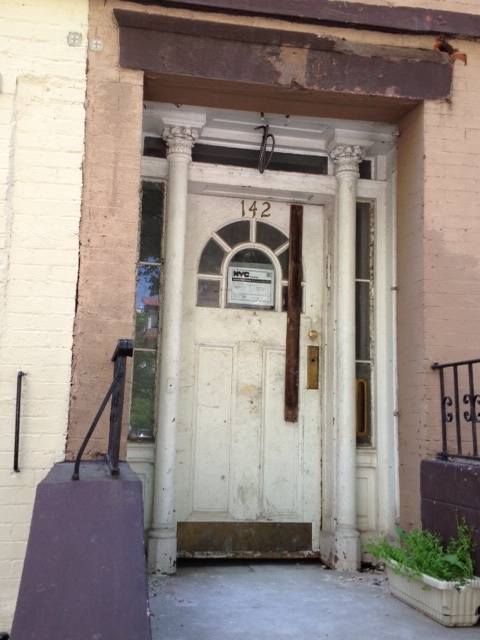
This beat-up old specimen, No. 142, best shows how the buildings used to look. Every window is still filled with glass. Painted white, all the details of the columns shine through. The address is currently under construction. Let's hope they preserve the look of the doorway.


No. 138, meanwhile, also has all its windows, though the door is more modern, and the columns seem to have vanished.