Showing posts with label prospect heights. Show all posts

Wednesday, 18 July 2012

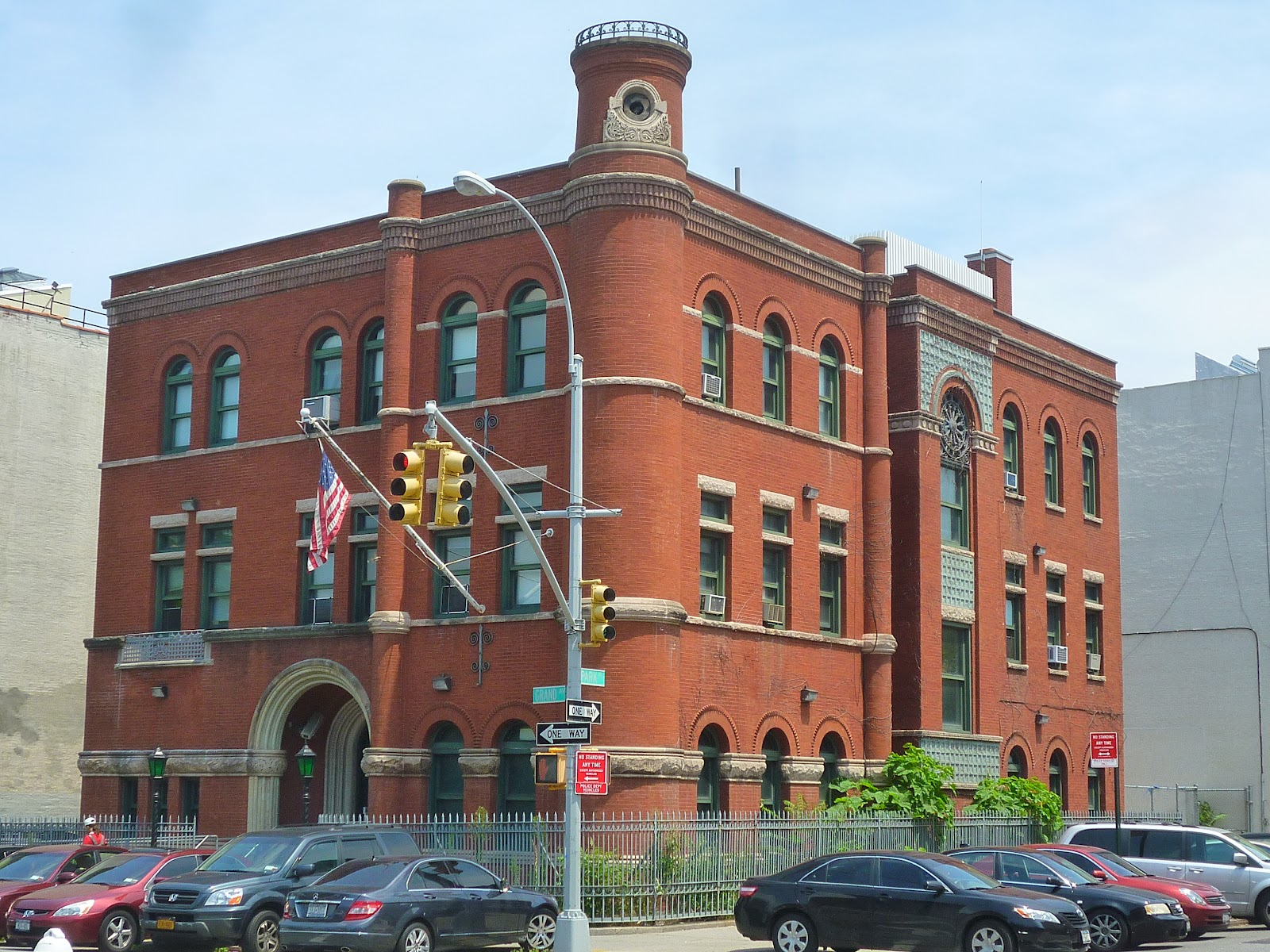
Some Precincts Are Luckier Than Others


Some police precincts are luckier than others. Many of New York's Finest have to inhabit a graceless bunker day in and day out. I'm thinking of awful modern concrete police buildings like the 76th Precinct on Union Street in my own Carroll Gardens.

Other officers, meanwhile, get to report to work every day at a castle.


This is the princely 22nd Precinct Station, at the corner of Grand Street and Park Place in Prospect Heights, Brooklyn. It was designed by architect George Ingram and was one of several handsome and austere, red-brick police stations he erected in Brooklyn in the late 19th century. (The 18th Precinct on Fourth Avenue in the 40s—also his—is a sad ruin in need of restoration.) He was also the engineer of the wonderful retractable Carroll Street Bridge which stretches across the Gowanus Canal!


The City awarded a contract of $35,000 to build the precinct building in 1891. Unlike some other Ingram works, the 22nd is still in use by the police. Police cars, standard and unmarked, are parked at the diagonal all around it. The building seems in fine condition. I have to guess it's had a restoration in the last 15 years. It's just too spruce. It dominates the area in bold, rosy color alone. And yet it's not mentioned at all in the current AIA Guide to New York City.


Tuesday, 17 July 2012

Wooden Phone Booth Sighting: Tom's Restaurant


In Tom's Restaurant, operating in Prospect Heights since 1936. Needless to say, like nearly all the phone booths in NYC now, it doesn't work. A chair blocks the entrance.

Friday, 13 July 2012

Lost Asks "Who Goes to Tom's Restaurant?"


Finally got around to doing a "Who Goes There?" about the Prospect Heights classic, Tom's Restaurant.
Who Goes There? Tom's Restaurant 
I am sitting in the morning at the diner on the corner. I wasn't waiting at the counter (I was at a table) or for the man to pour the coffee. I order a cherry lime rickey and it came pretty fast.
I was at Tom's Restaurant, a landmark diner in Prospect Heights since 1936. It's the kind of place where people order cherry lime rickeys and egg creams, not to mention breakfast all day, because they can. Near my table was a framed picture of the lyrics to "Tom's Diner." At the bottom, Suzanne Vega had signed it, "I Came. I Saw. I Wrote."
But she didn't. As much as I love Tom's Restaurant, and wish Vega's 1990 hit had been about it, the song was about Tom's Diner on The Upper West Side. You know, the "Seinfeld" diner. Vega herself has said so. So what's she doing giving Tom's Restaurant the credit? And what's Tom's Restaurant doing taking the credit? Curious.
But you have to expect a little bogus myth-making at a place this old. It opened as Lewnes, an ice cream parlor. Tom Vlahavas took it over in the 1940s. He's the Tom of the name, though the diner wasn't called that at first. Son Gus took over for Tom, and Gus himself retired last year, moving to Colorado. Gus sold the place to a nephew, Jimmy Kokotas. So it's still in the family.
There's a lot of stained-glass inside Tom's. I assume this is a relic from the place's ice cream parlor days. There are also great many flags, Christmas lights and plants, both real and fake. (One tree outside was planted in memory of old Tom.) These circus-is-in-town factors tend to obscure some of the restaurant's lovelier architectural aspects—the lovely, battered tilework on the floor; the oddly constructed wooden booths, which somehow evoke train travel; the old, now sadly unworking phone booth.
My waiter says people come from Manhattan and Queens to eat here. But it looked like mainly locals during my recent visit. Families with their kids, old folks with their spouses, young couples, solo diners (Tom's does not mind if one person takes up an entire booth), and small gangs of roving hipsters. Some have obviously been coming here for decades. Others were so new that they stared at their egg creams like they were archeological relics. A sign forbid the use of cell phones, some couldn't help themselves and resorted to texting.
The staff is inordinately cheerful, and is happy to relate the joint's history and extol the virtues of the many, many dishes, particularly the enormous number of breakfast entrees. I almost ordered the Salisbury steak because, outside of frozen dinners, who serves Salisbury steak anymore? My waiter told me more meatloaf was sold than Yankee pot roast, but more brisket was sold than meat loaf. You can't argue with the people, so I go the brisket. It was diner brisket. Not bad, moderately flavorful, with fluffy mashed potatoes and fresh, crisp broccoli. It was worth what I paid, which wasn't much.
—Brooks of Sheffield

Thursday, 12 July 2012

The Old Knox Hat Building


I've written about Brooklyn's old Knox Hat Factory in the past. The other day, I finally saw it with my own peepers.

I was strolling through an industrial section of Prospect Heights when I caught the profile of a blocky, handsome, yellow-brick building. It looked familiar. As I suspected it was the Knox Hat Works, which was built in 1890 and now functions as an apartment building. It dominates the intersection of St. Mark's and Grand Avenue. At the time of its erection, it was purported to be the largest hat factory in the world, and they made every conceivable type of headgear here, from top hats to straw boaters to policemen's helmets.


The building is in good shape. The yellow bricks are accented by red stone lintels and blue cornices. The cornerstone, seen above, is in good condition, as is at least one side of the inset street signs.

The Knox business was founded by Charles Knox in 1838 (the cornerstone has it wrong). The first store was at 110 Fulton in Manhattan. It was destroyed in a 1865 fire that also claimed P.T. Barnum's museum. Son Edward (who fought valiantly at Gettysburg and was once called "the most popular and handsomest officer in the encampment") rebuilt at 212 Broadway. Soon Edward decided the company should manufacture its own hats and built the Brooklyn factory, which once had a corner tower with a four-sided clock (now gone).


Edward Knox died in 1916, and the Knox Company merged with Dunlap Hats in 1918, which would eventually merge with other companies that formed the Hat Corporation of America. The factory was closed after World War II. Alfred Thompson turned the abandoned factory into 52 units of subsidized housing in the 1980s. 

And then there's this curiosity around the corner. The Knox Gourmet. Doesn't look open.