Thursday, 3 May 2012

Roof Message


I've passed by this old building at Broadway and S. 6th Street, which houses the Williamsburg Art and Historical Center, hundreds of times. I must be blind, because, until the other day, when approaching it from the west during a lovely sunset, I did not notice the spectacular roof tiling. It spells out, in red tiles, K.C. Savings Bank—that is, Kings County Savings Bank.

The building was erected in 1868 by the firm of King and Wilcox. King was none other than Gamalial King, the carpenter who created Brooklyn's Borough Hall. As the AIA Guide points out, it looks more like a millionaire's mansion than a bank. It was built in the French Second Empire style. The building operated as a bank until 1989. A restoration of the structure began in 1999.

Looking at past pictures of the building, I realize I may not have noticed the roof because it was sometimes covered with a billboard. 


Monday, 30 April 2012

The Fool With the Huge Obelisk


Think someone's overcompensating here?

Green-wood Cemetery has a lot of grandiose monuments erected by a lot of self-important people. But this one may take the cake. This obelisk marking the final resting place of Stephen M. Griswold may be the tallest in the cemetery. It's certainly the tallest I found during a recent tour of the western end of the famous burial ground.

So who was this grandee? Well, Griswold was famous in a way. But probably not in a way he would have liked.

A few weeks back I took a tour of the landmark Plymouth Church in Brooklyn, the one where Henry Ward Beecher was pastor. There I learned that a number of the parishioners were among the pilgrims that Mark Twain made fun of in his bestseller "Innocents Abroad." Apparently, Twain traveled to the Holy Land with the group in 1867—it was the first trans-Atlantic American cruise—and later used them as the models of the uncouth boobs featured in a series of articles, which were then collected into a book.

Griswold and his wife were in that group, and they were not portrayed in a favorable light. Maybe that indignity was what Griswold was trying to correct when his family commissioned this mile-high tombstone. Griswold was a jeweler otherwise, and the president of the Union Bank of Brooklyn, though he was a New York State Senator from 1886 to 1887. Guess his voters didn't read much Twain.

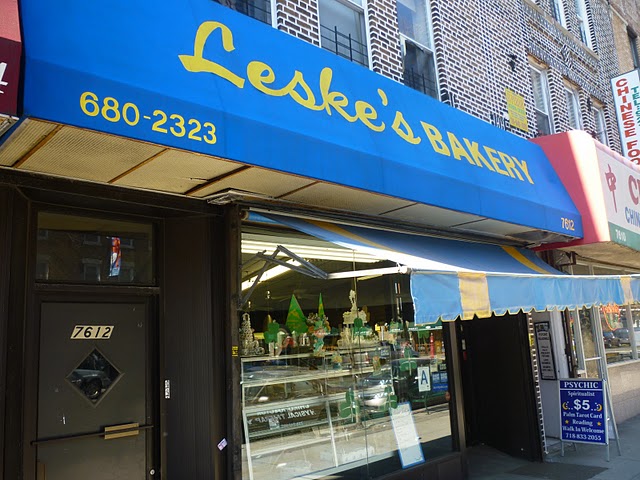
Leske's Bakery in Bay Ridge to Reopen


Last May, Leske's, the last Scandinavian bake shop in the one-time Norse stronghold of Bay Ridge, closed. And so the Brooklyn neighborhood lost one of oldest businesses, and one of the last vestiges of Swedish Brooklyn.

Now, it seems, Leske's is getting a new lease on life. I was in the area the other day and saw some workers hanging outside the bakery. Investigating, I found a couple articles and notices taped to the windows saying that the shop was due to reopen. Signs said Leske's would have new management, but the same bakers it had before. It will reopen in May.

I'm glad it's reopening, but the fact that it will have the same bakers is a matter of some concern. When I first posted something about Leske's, a received a few comments from old timers saying how the quality of the baking had gone done in recent years. Yesterday, I even received a message from a descendent of the founder: "Being the granddaughter of the founder of Leske's Bakery, nothing is like it use to be back then. My mother constantly raves of the donuts and black and whites, but everytime we've gone back, they were never like they use to be." Perhaps the previous management wasn't letting the bakers bake the way they wanted to. We shall see.

Friday, 27 April 2012

The Brooklyn Theatre Fire, Etched in Stone


Perhaps because the location where it happened has been thoroughly sandpapered off the map, the great Brooklyn Theatre Fire of 1876 is little remembered today, except by the most searching of New York history nerds.

The disaster laid waste to the Brooklyn Theatre, which stood at the corner of Washington and Johnson Streets, one block north of what was then City Hall, and is today Borough Hall. Cadman Plaza occupies the area today. On Dec. 5, 1876, a fire broke out on stage during a performance. One thousand people were in attendance; at least 278 died. It remains the third most deadly fire to have occurred in a theatre or public assembly building in the U.S.

The main reminder of this catastrophe stands in Green-Wood Cemetery. It's an obelisk that spells out, in scrupulous detail over the four sides of the monument, what happened at the theatre. The remains of 103 of the victims are buried beneath. The inscription may seem over-explicit at first. But it's a good thing the people who erected it went into such detail. It's a compact history lesson for New Yorkers who today know nothing of the tragedy.


Thursday, 26 April 2012

Historic Brooklyn Florist McGovern-Weir Shutters


The McGovern-Weir Florist, on the western border of Green-Wood Cemetery Sunset Park, has closed up shop. On a recent visit, I found the roller-shutter down and the interior emptied.

However, this cessation of business appears to be good news for the 132-year-old structure, the only Victorian-era greenhouse still standing in New York. For the building was sold to none other that Green-Wood Cemetery, which bought it for 1.6 million. The cemetery plans to restore the lovely creation.

The greenhouse was built by James Weir, Jr. (son of founding florist James Weir), in 1880, at the corner of 25th Street and Fifth Avenue. Architect Mercein Thomas designed the glass and wood building. Fifteen years later, Weir hired architect George Curtis Gillespie to enlarge the greenhouse. The sign at top was once visible from a great distance. Weir and his two sons, James E. and Edward, all lived on 25th Street near the greenhouse.

Green-Wood also bought a building adjacent to the greenhouse. Though it is covered in aluminum siding, you can tell the house is very old from its ornate wooden cornice. Here's are some pictures of the building and the interior of the greenhouse, taken during a visit in 2009.

Weir Florist is still a going concern. They have a store on Montague Street in Brooklyn Heights. 

Wednesday, 25 April 2012

Timboo's, Classic Brooklyn Dive, Closes


Timboo's, a classic old dive on Fifth Avenue in the South Slope, has served its last Bud.

I passed by recently, and found the bar, which was founded in 1969, had been supplanted by a cheery-looking place with the cheery name of Skylark.

Timboo's was the haunt of rummies and barflies, the folks who lived in south Park Slope when it was seedy and dangerous and ungentrified. It was a roomy saloon, with a big pool room in the back. The facade was priceless: a mirrored black glass sign with the faded, cursive white lettering and badly drawn Martini glasses, glass bricks, and a sun-bleached awning. A couple years ago, the bar tried to spruce up its act a bit, getting a new awning and replacing the old sign with a new facsimile. It was a mistake.

A reader told me at the time (June 2009) that the owners lived in Florida part-time, and Timboo's was now run by their daughters. Skylark is run by the same people who own Abeline's, a bar on Court Street in Carroll Gardens. At least it will be taken over by local people.

The weird name, by the way, was a conflation of the first name and last name of the two owners: Timmy Hodgens and Bobby Booras. Guess we could have been stuck with Hodbob's Bar all these years.

Tuesday, 24 April 2012

Kenny's Castaways on It's Way Out?


Bleecker Street may be touristy. It may teem with bridge and tunnel types, an NYU students on the weekends. It may be a long way from the heady music cred days of the 1960s Village folk revival and the 1970s punk insurgence. But the strip has endurance. There's minimal turnover. Many of the same bars and small-time clubs that were there in Dylan's day are there now, including the Back Fence and Bitter End.

One of the oldest, Kenny's Castaways, at 157 Bleecker, may not be long for this world. Eater reported that the Bleecker Street stalwart in on the block, looking for the highest bidder. The owners have tired of the place and are fishing around for a buyer.

The building has a long history. In the 1890s, it was an early gay bar by the name of The Slide, called the wickedest place in New York by the New York Herald. The basement functioned as a brothel. The ceiling, woodwork, and ceramic tile floor from those days are still visible today.

It became Kenny's Castaways in 1974. The first Kenny's was located on E. 84th Street. When the lease was up in 1974, the club moved to Bleecker Street. 

Kenny was Pat Kenny, and his family still owns it. Many a gritty 1970s musical luminary played here: Jeff Buckley, New York Dolls (who played both at the 84th Street location and on Bleecker), Ricky Lee Jones, Steve Forbert, Blondie, Kiss, Patti Smith. Bruce Springsteen performed at the 84th Street Kenny's for a week in 1972. The Smithereens were the house band around 1980. Phish gave its first Gotham concert here in 1988. Joey and DeeDee Ramone met here. And, yes, Spin Doctors played here. 

Ashamed to say I have never been to Kenny's. I will correct that.