Showing posts with label greenwich village. Show all posts

Wednesday, 3 April 2013

Lost City Asks "Who Goes to Arturo's?"


From last week's "Who Goes There?" column on Eater. Wish their pizza was better. (People: better quality tomatoes and a pinch of basil and salt in your sauce, and your problems are solved!) But I have no complaints about the ambiance.


Who Goes There? Arturo's
Among New York City's long-playing pizzerias, Arturo's stands out in a few ways. Its founder, Arturo Giunta (who died in 2006), was in no way connected to the famous Lombardi's pizza family tree that begat Totonno's, Patsy's, and John's, among others. Compared to those storied joints, it's rarely written up, or places in the regularly published top ten lists of New York pie palaces. And it doesn't feel like a tourist trap, the way other pizza destinations can.
Moreover, Arturo's—still on the same corner (Houston and Sullivan) where it flung open its doors in 1957—retains a raffish, scruffy charm that most of Greenwich Village lost long ago. It's not just that the ceilings are tin and battered; that there are countless signed celebrity head shots on the walls; that bad oil paintings by amateur artist Arturo occupy the spaces not taken up by actor photos; that nobody can remember who painted the large fading murals, or what scene they're supposed to depict; or that they used to perform plays in the back room in the '70s. It's more that, in very Old School Villagey style, Arturo's still has live jazz music every day. It's that the staff all seem to be ancient or bohemian or somebody's underperforming relative. This is a classic New York staff, and they're part of the place the way ivy's part of a wall. The young waitress wears cat-eye glasses and a leather skirt. The manager looks like a librarian at an alternative-reading library. When the genial greeter in the baseball cap introduced me to the owner, she sized me up and said, "Who is this?" A customer, the greeter said. "Oh, mystery man!"
Arturo's doesn't hurt for business. I arrived at opening time one weekend day, and there were already people there. A half hour in, the place was packed. "This is nothing," my waiter said. "You should see us on Saturday night. Line down the block." Who comes? "Everybody." Tourists? "Yeah, lots of tourists. Celebrities." Locals. "Lots of locals. Been coming for years." Most of the diners I saw were locals. Some spoke foreign tongues, but even they seemed used to the place.
The pizza? Well, it's fine. The crust is a bit thick, the sauce a bit bland. I put a lot of crushed red pepper and Parmesan on mine to give it a kick of flavor. I'd be fine with the level of quality if the prices weren't so high. Plain pies begin at $17 for a small; $20 for a large. Extra toppings are four dollars and up. Those are close to Lucali prices. And Lucali's a lot better. Also, Arturo's seemingly has no excuse for the pricy tariff; the family owns the building and are presumedly not under the pressure of making the rent.
But, you know, so what? Lucali doesn't have this atmosphere, this old Village charm, this family atmosphere, this joyous corner vista past which windows—on which are painted fading letters that tempt you, tantalizingly, with "Air-Conditioning"—all of New York seems to pass. Even nearby John's, a slice of potent Village ambience itself, can't quite compare to the transporting Arturo's mise-en-scene. If you're fond of that romantic version of New York many of us hold in our fuzzy, nostalgic-addled heads, it's a happy-making space.
—Brooks of Sheffield

Tuesday, 19 March 2013

Lost City Asks, "Who Goes to El Charro?"


El Charro, in Greenwich Village, is the definition of a hidden gem. So hidden that I didn't even know it existed until someone at El Parador—the city's oldest Mexican restaurant—told me or a family connection between the two old restaurants. The small, basement place is so quiet and secluded, I recommend it as an escape from reality any time you've had a bad day. Here's my column:
Who Goes There? El Charro
I had a moment of déjà vu as I walked down the few steps into the restaurant tucked into 4 Charles St. Quiet Village street; basement space; tiny room; low ceilings; small bar to the left. Was I in Fedora? The real Fedora, I mean, not the impostor currently sailing under that name on West 4th Street.
Of course, I wasn't Fedora has gone the way of other fine New York institutions who have discovered the hard way that the brutal economics of 21st-century New York have no place for them. But El Charro Español is that kind of place. It's what pops into your mind when you picture the typical, side-street Greenwich Village eatery of old: cozy, slightly hidden, tradition-bound, attentive to its regulars, and offering the diner not a raucous jolt of energy but a relaxing respite from the world. 
El Charro's exact age is hard to determine, but it's probably been here for about 60 years, gathering minimal press attention, but a faithful clientele that it made almost entirely of locals. This is a neighborhood joint. It began as a Mexican restaurant, a culinary rarity in those post-WWII days. It was run by Maria Garcia. (Her daughter married Carlos Jacott, who went on to found El Parador on East 34th Street, which still stands and is today the city's oldest Mexican restaurant.) El Charro remained a Mexican place at least into the '80s, but today, under its current owners, it is a Spanish restaurant, and a good one.I ordered a sangria when I saw that the bartender was mixing them separately, constructing each in the glass, rather than pouring the potion out of a pitcher. The Shrimp Ajillo, sauteed in olive oil, garlic and hot pepper, was beautifully done: simple, tender and subtly spicy. For my entree (which came with one of those comforting—but not necessarily good — side salads slathered in French dressing) I had Pollo Villaroy, two breasts of chicken coated with bechamel sauce and bread crumbs and deep fried. It was tasty, but perhaps too filling. Though I liked it, I could have done with a half order.
The restaurant seems to have been recently spruced up; the exterior is in picturesque, pristine condition and the signage is small and classy. But the room's age is betrayed in the details: the old cash register; the old-fashioned punch clock for employees; and the thin, narrow staircase to the tiny bathroom. (Please take note of the oil painting of a sad clown as you pass.)
The ratio of staff to patron was about one to two the night I was there. So it's no surprise that service was attentive. Or maybe I should not take that for granted. I've been in plenty of contemporary restaurants stuffed with waiters and still had a hard time getting anyone's attention. Old friends were catching up at one table, a mother and a daughter at a second. Making the most noise were two men having a convivial business meeting, the larger, older one a longtime regular feeling very at home, the younger, thinner one a newcomer who seemed to want to be in a steak house. He ordered a filet mignon ("Can you butterfly that?") and called out for A-1 Sauce. "Are you complaining about this place?" his hefty friend asked in comic disbelief. "Are you COMPLAINING about this place."
I was sympathetic. I mean, seriously, dude, are you complaining about this place?
—Brooks of Sheffield

Saturday, 20 October 2012

Lost City Asks "Who Goes to John's Pizzeria?"


As the number of artisanal pizza options has risen in New York City over the last decade—as well as the pitch of the debate as to which serves the best and most authentic pie—I've come to rely on, and cherish, old standbys more and more: Totonno's, Arturo's, Patsy's, Sam's, and, of course, John's in Greenwich Village. Here's my latest "Who Goes There?" column from Eater:
Who Goes There? John's Pizzeria
John's Pizzeria doesn't get the respect accorded to other old New York pizza institutions, like Patsy's, Totonno's, or Di Fara. Nor does it get its due as a Greenwich Village icon the way places like the White Horse Tavern, Village Vanguard, or Cafe Reggio do. This, I imagine, is because it's a tourist magnet and perpetually filled to the gills with regular (i.e., uncool) people.
But, for me, John's holds up. The plain pie is not the city's crowing achievement of the pizzaiola's art. But it's good enough to be a standard bearer. The tang of its sauce and the char of the crust are remarkably consistent; the coal-fired brick ovens are still doing their job. I've never had an unsatisfying pie there. And, unlike Lombardi's—another landmark in New York pizza history, but one that is now a theme-park shell of what it once was—John's has retained its character. The main room—with its high, red tin ceilings, twitching ceiling fans, vintage concert posters, and battered wooden booths etched with the names of decades of whittling patrons—is simply one of the greatest, New Yorkiest spaces in the city. One can imagine the Italian denizens of Bleecker Street eating here in the 1930s and '40s; the jazzmen and beatniks of the '50s; the folkies and flower children of the '60s. History lives here.
Despite its reputation as a fave of the weekend bridge-and-tunnel tribe, John's still gets plenty of locals. It also attracts a lot of families, because no one blinks at kids being kids here. I recently dined here with eight tweens, and they couldn't have felt more at home. They inhaled the slices and happily poured themselves glass after glass of Coke from plastic pitchers. They also found the ancient bathrooms an infinite source of fascination.
John's was founded in 1929 by John Sasso, who reportedly learned his trade at Lombardi's (as did the founders of Totonno's and Patsy's). The original pizzeria was on Sullivan Street. When Sasso lost his lease, he dismantled the brick oven and moved it to the present location on Bleecker. There it has stayed. Sasso sold the pizzeria to his brother in 1955. It was eventually taken over, in 1973, by Sasso's great-grandnephews, Peter Castellotti and Robert Vittoria. It's still run by Peter (who was born in a building directly across the street from the restaurant) and his children, Peter Jr. and Lisa. During the Castellotti reign, John's began to expand. There are now three other restaurants, including a massive one in a former church space in Times Square. The latter is always swamped, with 45 minutes waits, because it's one of the only affordable eating options in the Theatre District. The pizza, however, doesn't match what's served up on Bleecker Street. You can't duplicate the effects of an 83-year-old oven. 
—Brooks of Sheffield

Wednesday, 17 October 2012

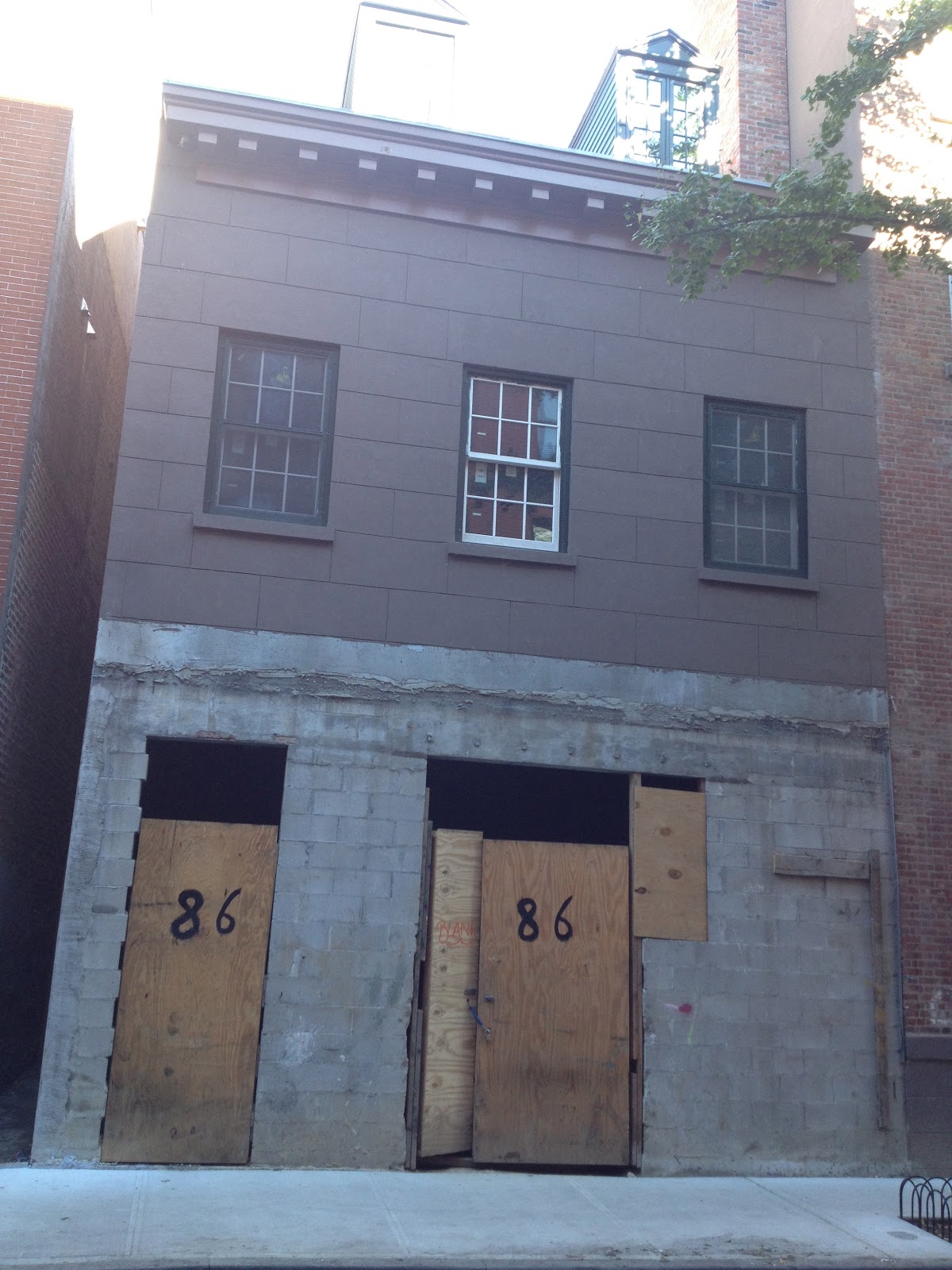
They Got the Number Right


The world is still waiting for Greenwich Village's classic speakeasy, Chumley's, to come back from the dead. But here's a good sign. The joint's iconic address is back up!

Many theorize that the term "86"—as in scram, nix that, lose that, get rid of that, cancel—derived from Chumley's address of 86 Bedford Street. Whenever the cops would raid the speakeasy, the bartender would get a heads up, and the patrons would quickly file out the back door into a courtyard that led to Barrow street. The customers were "86"'d.

I spoke to the new owner a few weeks ago. There had been various reports that the bar would open this fall. He told me the reports were inaccurate and that there was no guarantee that he's open for business by Dec. 31, although he wished he would. I could tell by the tone of his voice that he was doubtful he would, though.

However, seeing the old number 86 back where it belongs warms the heart.


Wednesday, 10 October 2012

El Faro Indefinitely Shuttered


According to Eater and various sources, El Faro, one of the oldest Spanish restaurants in the City, and one of the oldest period, will be shuttered indefinitely followed a visit by the health department that forced it to temporarily close its doors. The owner, Mark Lurgis, said he has to raise $80,000 to make the necessary changes and will stay closed until he does so. (No doubt, the DOH charged its usual ludicrous inflated fees.) The restaurant's kitchen is 150 years old.

Ironically, this is the restaurant I had planned to visit for my most recent "Who Goes There?" column. The night I scheduled to visit was the night it closed. I changed my plans and visited El Quijote, another Spanish standby, instead.


Wednesday, 22 August 2012

Lafayette French Pastry Closes


I'd noticed recently that Greenwich Village's Lafayette French Pastry looked closed, but I thought perhaps the owners were on summer vacation. I learned today from Eater that the longstanding baker had shuttered for good. Taking over the space will be the irrepressible New York culinary world loudmouth Michael Bao.

This was actually Lafayette's second location in the Village. It used to be on Bleecker Street near Seventh Avenue. It moved about 15 years ago, replaced by a Burritoville which has since vanished. In that guise, it epitomized, for me, the Greenwich Village small business, full of effortless local character. Lafayette was around 85 years old, run by three generations of the same family, a real relic of the old Village. According to their Facebook page, the owners got a letter of eviction in June.

Thursday, 24 May 2012

The "Incredibly Good Idea" of La Groceria


Here's a nice picture. A reader sent it to me asking if I knew anything about this Greenwich Village restaurant, which sat at the wedge-like space where Sixth Avenue meets W. 4th. (There's a Grey's Papaya there now.)

I did find something out about it. It opened in 1963 and was hailed by Craig Claiborne, the New York Times restaurant critic, as "an incredibly good idea...The restaurant is modeled after an Italian trattoria, and is a combination espresso shop and dining establishment with antipasto, pasta dishes and main courses." Imagine a New York foodie world in which that sort of thing would have been novel.

The place earned its name because it also sold Italian products from its shelves. Though Claiborne liked the "idea" of La Groceria, he was disappointed in the execution. The antipasto was "trite," the pasta "overcooked," the sauce "amateur." The espresso, however, was "excellent."

La Groceria was opened by Vito A. DiLucia, a restauranteur who seemed to favor theme joints. His other restaurants were O'Henry's Steak House and the English Pub. Formerly, he had been a travel agent. He died in 1970 at the age of 67.

La Groceria was still there in the mid-'80s. Not sure when it closed. But it wasn't there in 1988, when I hit town. 

Tuesday, 15 May 2012

Star Shoe Shop, Village Survivor


I have walked by the Star Shoe Shop on Bleecker Street, near Crosby Street right by the Two Boots pizza, for decades and not quite grasped how old it is until I went in recent and got my shoes shined. Ready? It's been there more than 70 years. Unbelievable.


There's not much inside to betray that level of age, though if you peak back where the small bathroom is, you'll see some ceramic floor tiles that look fairly ancient. Otherwise, the feel is very 1970s. Fake wood paneling, standard issue wall clock, a small television set embedded into the wall behind the counter. And a couple photographs featuring the shop as a backdrop: one of an unidentified CBGB band from the club's golden age; and one of Christopher Walken back when he was young, handsome and not yet too weird.

The photos reveal that the neon sign in the window has not changed in the last four decades. I'd guess the same holds true for the yellow sign hanging outside, as well, since it features a phone number without an area code.


The world inside is very old Village. Vagrants, drifters, grifters and neighborhood eccentrics seem to recognize that they will not be given the bum's rush from the accented old men who run this cluttered shop. While I was there, a grizzled old rummy with a three-day growth and a cig hanging from his mouth came in and tried to sell a few items from out of a large trash bag. The owner seemed to be entertaining his offers. Clearly the man had made some sales in the past.

The man who shined my shoes took a lot of care and time on my zapatos. Glad I wasn't in a hurry.

Wednesday, 7 March 2012

Harry Chong Laundry Sign Comes Down


Harry Chong, an old-school laundry man, closed up his shop on Dec. 31, 2005, after 60 years in business. But the sign remained, despite the businesses that took up residence there. Until yesterday, when a sharp-eyed reader caught these two men in the act of cultural vandalism. Sad